


{ 90% of the trucking industry runs on small fleets. Most of them can't afford a data analyst. Fleet Assist is a conversational AI tool proposed to be built into Volvo Connect that gives every fleet manager, regardless of team size or technical background, the ability to understand and act on their data. }






The trucking industry relies on data for efficiency, safety, and profitability. Volvo Group supports this through Volvo Connect, a platform that gives fleet managers visibility into KPIs like fuel efficiency, driver behavior, and maintenance alerts.

These KPIs are being collected by sensors embedded on each truck. Monitoring these KPIs is essential not only to make sure operations are running successfully and drivers are safe, but also maintaining a truck's health is critical.
{ Only 1% of Volvo's total customer base actively uses Volvo Connect today. Volvo came to us because adoption and retention was low but they didn't know why. }

To understand the specifics and scope of the problem, we conducted 8 exploratory interviews and 4 contextual inquiries with fleet managers across different company sizes.

In-depth conversations to uncover workflows, pain points, and unmet needs.

Synthesized existing research on fleet management challenges and best practices for dashboard design.

Observations to see how fleet managers interact with Volvo Connect in real-world settings.

Assessed industry competitors to identify strengths, gaps, and opportunities for Volvo Connect.

The current dashboard requires managers to jump between maps, reports, and analytics to find what matters, slowing decision-making.

Small fleets depend heavily on dealerships for onboarding and interpreting data, creating friction and delays.

They're juggling too many systems at once, making it easy to miss important tasks like maintenance scheduling.
{ In summary, the way information lived on the platform cost too much time, required external support, and was ill-organized. }
{ How do we bridge the gap between complex telematics data and clear, actionable insights for small fleets? }
We started exploring concepts: simplified dashboards, guided workflows, curated reports, and conversational AI. We narrowed it down to dashboard redesign and conversational AI because both could incorporate guided workflows and curated reports.
As a team we were slightly inclined toward conversational AI because we thought it could better cut down time and give users more ways to interact with their data.
We narrowed it down to dashboard redesign and conversational AI because both could incorporate guided workflows and curated reports. As a team we were slightly inclined toward conversational AI because we thought it could better cut down time and give users more ways to interact with their data.
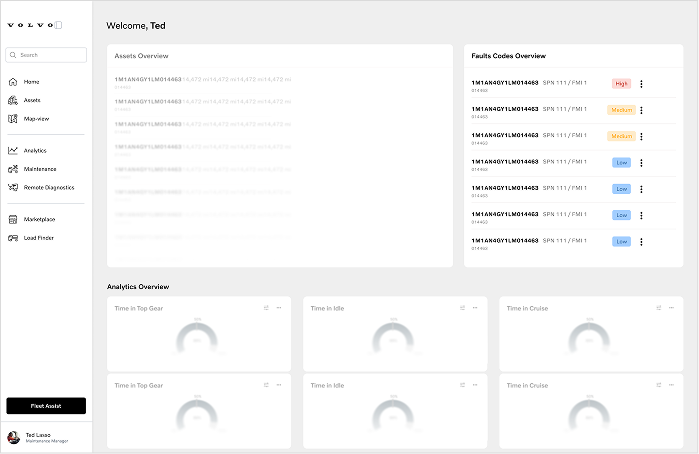
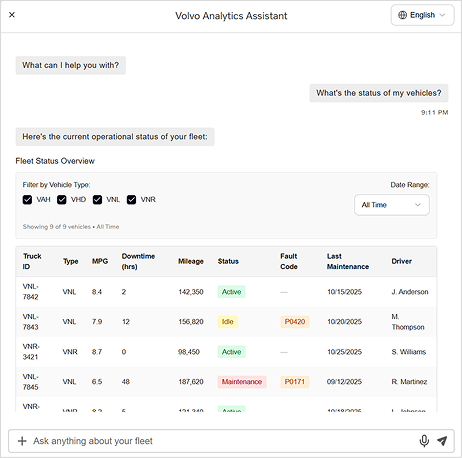
When my team and I presented both possible solutions, there was significant hesitation from our North American Volvo Connect panel when it came to the conversational AI tool. One panelist flat-out said 'no'. AI felt expensive and risky. But they were still open to seeing what an AI solution would look like if that's what the research supported.
{ Volvo NA team hesitation: AI is expensive and will our user base be ready to adopt it? }
To address these hesitations, my team and I put together a plan.
We started off with concept testing to understand which solution would be better. We presented both a redesigned dashboard and a conversational AI tool to users and found that conversational AI would be the strongest direction.
To validate feasibility, we investigated Volvo Connect's existing tech stack and discovered they were already paying for Amazon QuickSight, which had recently added built-in AI capabilities, without leveraging it. After connecting with Volvo's engineering team, they confirmed our conversational AI solution was achievable within their existing infrastructure. This was a pivotal moment: we could unlock value for 90% of an underserved market without requiring new resources.
We then crafted our prototype and tested it through rapid iteration via 8 usability sessions. Three themes emerged: users needed guidance for different situations, streamlined information discovery, and accessibility regardless of expertise. Through each test we improved the tool to not just offer simplified data display but act as an assistant that provided clear, actionable guidance. We achieved 90% user satisfaction.
To capture diverse insights, we recruited across three career categories: Technical & Analytics Roles , Sales & Service Operations Roles, and Product, Customer, & Business Leadership Roles. This distribution allowed us to gather feedback from participants with varying skill sets and responsibilities, including analytics experts, diagnostics managers, product managers, service managers, and executives. We also tried to do our best to be gender inclusive to get the voices of women especially in such a male dominated field. Geographically, participants were located across three U.S. states: North Carolina , Ohio, and California, providing perspectives from multiple organizational contexts and market environments within the fleet management industry.
Testing revealed three key insights that directly shaped our final design decisions.
Participants mentioned they had to search across multiple pages and tabs to find what they needed. One participant noted they didn't want to click around 15 times. So we made the conversational query the primary entry point, bringing answers directly to the manager instead of requiring them to navigate across the platform.
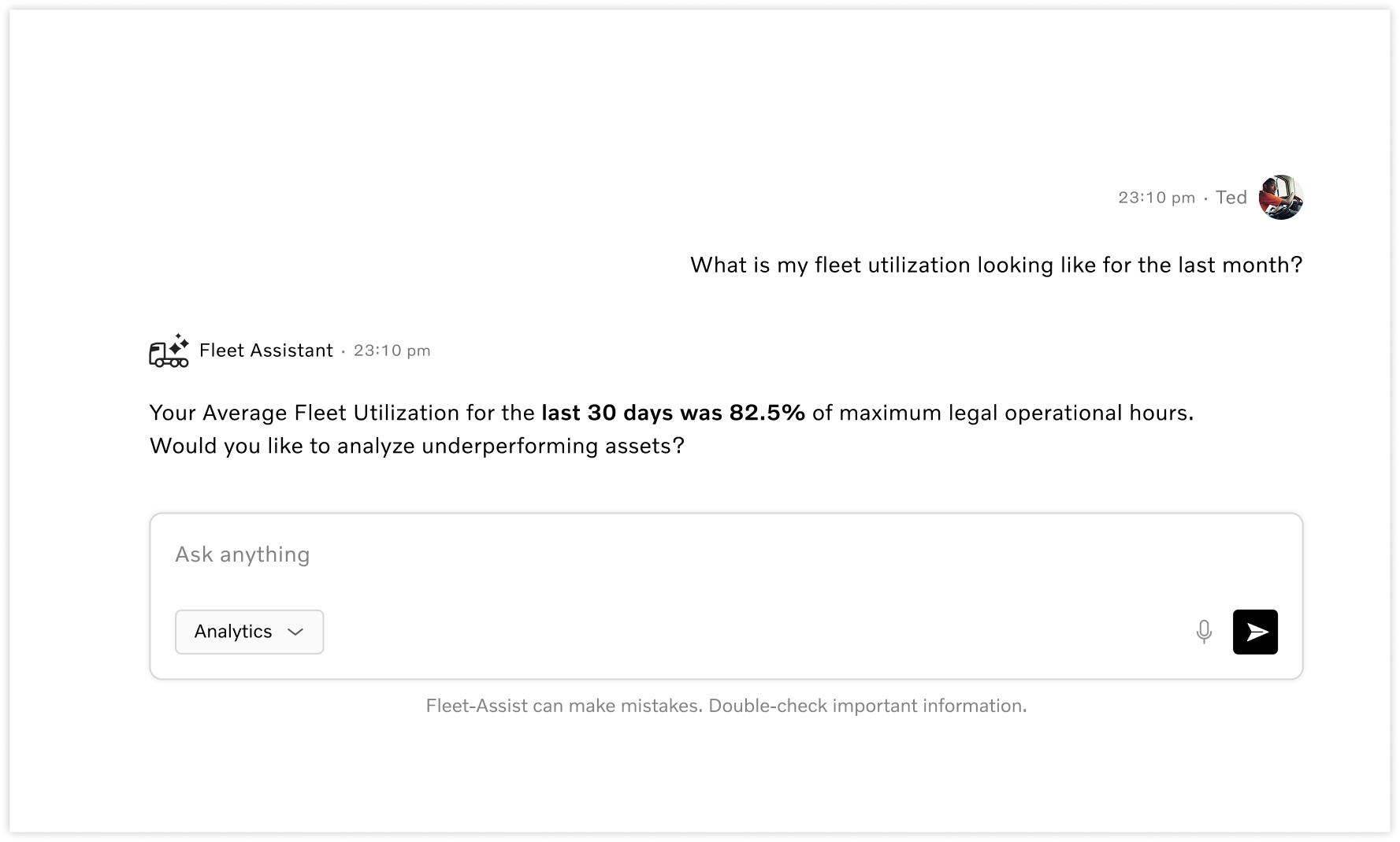
Participants mentioned they had to search across multiple pages and tabs to find what they needed. One participant noted they didn't want to click around 15 times. So we made the conversational query the primary entry point, bringing answers directly to the manager instead of requiring them to navigate across the platform.

Participants with varying technical backgrounds needed the AI to feel transparent and easy to follow. So we added thinking statements, guided follow-up prompts, and plain-language summaries to make Fleet Assist feel like a knowledgeable colleague rather than a black box.

Finally, we presented our refined prototype to the North American Team again. This time armed with evidence: they already had the infrastructure, 90% user satisfaction from testing, and a prototype showcasing specific use cases our users felt would have the most impact.
We received unanimous support. The skeptic who had outright rejected an AI solution became our strongest advocate. She said the proactive insights capability should be front-and-center for the entire project.

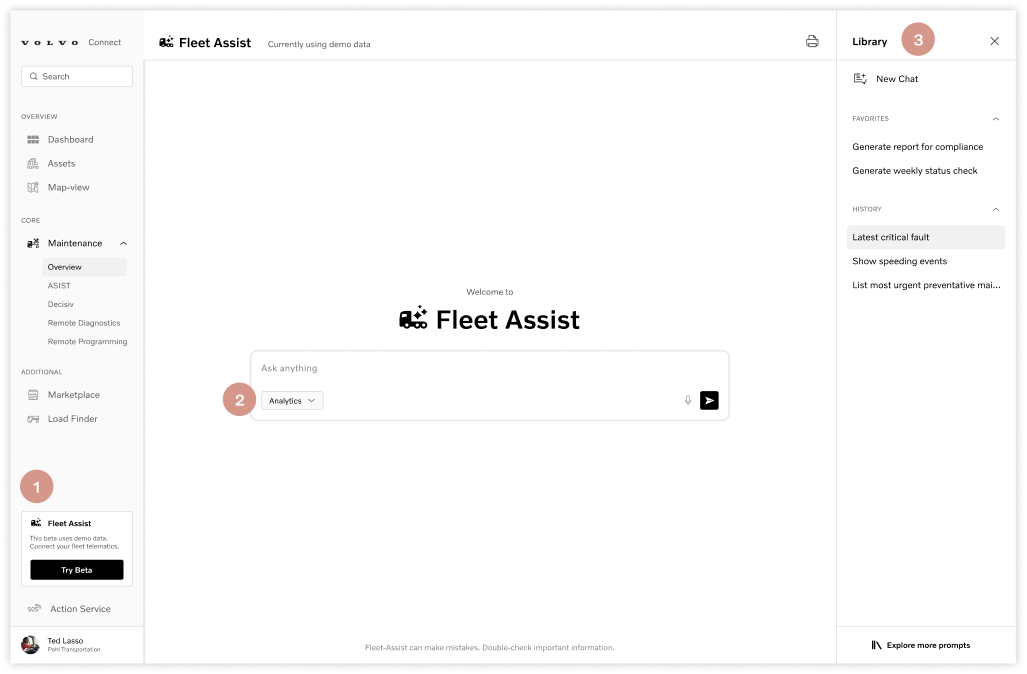
Here is an overview of Fleet Assist's structure and 2 primary use cases.
Fleet Assist Beta Call Out:
This is the button that users will use to navigate to Fleet Assist.
Query type specification:
This drop down allows user to specify what kind of questions they are going to ask so that the AI will think better along those lines. So if you want some thing analyzed you would select Analytics in the drop down to let the AI know that you want to tackle analytics.
Right Side Library:
On the right, fleet managers can view their chat history and see suggested prompts, which helps onboard new users into the capabilities of Fleet Assist.

Let's posit a use case here. As a fleet manager, you're constantly working to improve margins and optimize fleet performance. One effective way to do this is by analyzing fuel efficiency over time. So, let's say a manager wants to view fuel efficiency for the last 20 days.
Fleet Assist will provide an overview of the fuel efficiency within seconds.
Users can follow up with a drilling question to see why a certain vehicle is underperforming.
Fleet Assist will tell the users what are some causes for the underperformance, along with an analysis and summary of the situation. This cuts down the time for hunting and crafting meaning from the data and allowing users to act on issues immediately.
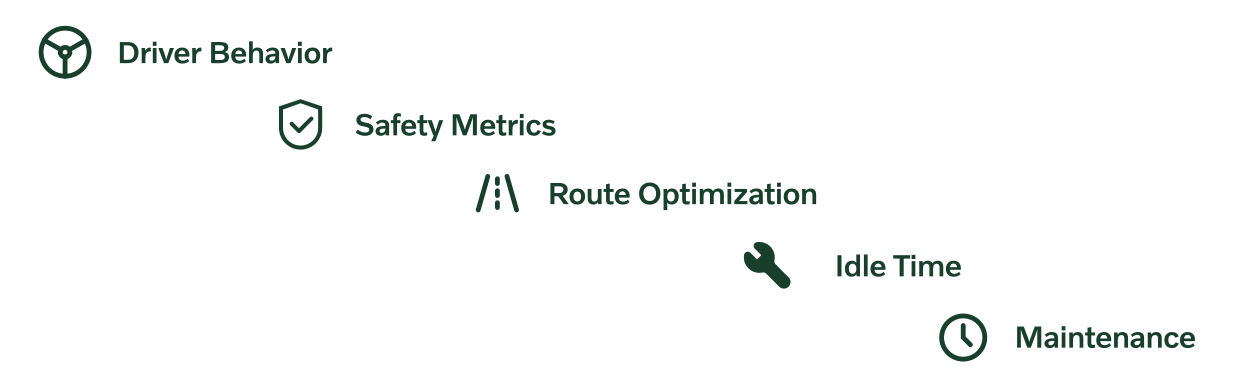
{ Analysis isn't just limited to just fuel efficiency, managers can ask for clarity on data for a plethora of metrics some that are listed below. }
Another use case is understanding singular data points. Volvo Connect holds lots of data. So we wanted to give users the ability to drill down on singular pieces of data. Let's take a look at this table which lists fault codes that correlate to an issue that appears on a truck. It's extremely important for a fleet manager to stay on top of these faults to ensure their vehicles stay on the road. Clicking on the arrow will send the fault code with all its context, straight into Fleet Assist, and users can get an explanation for this data point.
Fleet Assist generates an analysis, unpacking the meaning of the fault code and the monthly trend for the fault code. Assist will also give guidance on what immediate actions to be taken in each use case. After providing immediate safety measures, Fleet Assist will give two options to take care of the situation. Either you can send a report to a Volvo Dealership or users can chose to take care of the issues themselves.
Dealership Option
If users pick to reach out to a dealership, Fleet Assist will send out a report to the nearest dealer along with a number for roadside assistance.
Self Repair Option
If users choose to fix it themselves, Fleet Assist will provide a supply list and instructions.

1
Recruitment Challenge
Engaging with small-fleet managers for evaluating our design work proved challenging given our limited network and their packed schedules. By working with our sponsors to connect with internal Volvo professionals and conducting a local dealership visit, we were able to gather the feedback we needed.
2
Time Constraint
Given additional time, we would have liked to explore the maintenance aspect of our solution more deeply, as it represents a niche area of the industry that deserves careful attention. Even within our time constraint, Fleet Assist was designed to provide meaningful support for maintenance tasks, ensuring value for this part of the industry.

We developed a solution that supports Volvo's most underserved users while also benefiting those with more resources.
Fleet Assist removes the barrier that causes small fleets to abandon the platform, their inability to extract value from data. From a business perspective, this directly addresses Volvo's retention problem and unlocks 90% of their addressable market using existing infrastructure.
Another impact our work had beyond Fleet Assist was that our research showed the general navigation needed rethinking. The greater North America team was able to use our work and added a left nav bar to the platform based on our findings. We gave them not just a solution, but evidence for restructuring to better support users.
This project taught me that ambiguity, while uncomfortable, creates space for the most meaningful design decisions. Without a clearly defined solution from the start, our team was pushed to explore broadly, which is ultimately what led us to conversational AI over a simpler dashboard redesign. The most pivotal moment came through cross-functional collaboration, when we discovered Volvo was already paying for Amazon QuickSight with built-in AI capabilities they weren't using. That conversation with engineering didn't just validate our direction, it unlocked a solution that required no new resources and could reach 90% of an underserved market. Finally, this project deepened my understanding of accessibility as meeting users where they are. Fleet managers aren't data analysts. They're busy, often stressed, managing multiple systems at once. Real accessibility meant plain language, guided follow-ups, and an interface that felt like talking to a knowledgeable colleague rather than reading a dashboard.

